
From the dawn of human thought, the Aether has inhabited the threshold between the visible and the invisible, the measurable and the sacred. Its name echoes across the pages of philosophers and mystics, astronomers and alchemists, as a lingering trace of what could never be extinguished: the intuition of a primordial fabric sustaining existence itself.
The Aether in Philosophy and Science
In classical Greece, Aristotle named it quinta essentia—the pure substance of the heavens, distinct from the four earthly elements. Plato, in his cosmology, had already suggested the necessity of an intangible principle binding the celestial dance of the stars. For the Stoics, the Aether was pneuma, the vital breath pervading the cosmos.
During the Middle Ages and the Renaissance, the Aether became central to astrology, alchemy, and hermetic dreams. Kepler, envisioning the music of the spheres, assumed that planetary harmonies could not move through emptiness, but through a subtle medium.
With the rise of modern science, the Aether became the “luminiferous ether,” the hypothetical medium carrying light. Yet the Michelson–Morley experiment in 1887 failed to detect it, paving the way for Einstein’s relativity. Expelled from physics, the Aether persisted nevertheless in the symbolic and spiritual imagination.
The Aether as Esoteric Fabric
Hermetic and alchemical traditions never reduced it to a medium; they saw it as the subtle energy uniting spirit and matter, the bridge between visible and invisible planes.
In Greek mythology, Aithér was the deity of pure light, distinct from the coarse air of mortals—the very atmosphere of the gods. In Hindu tradition, its parallel is Akasha, the primordial space in which all that has been and will be is inscribed.
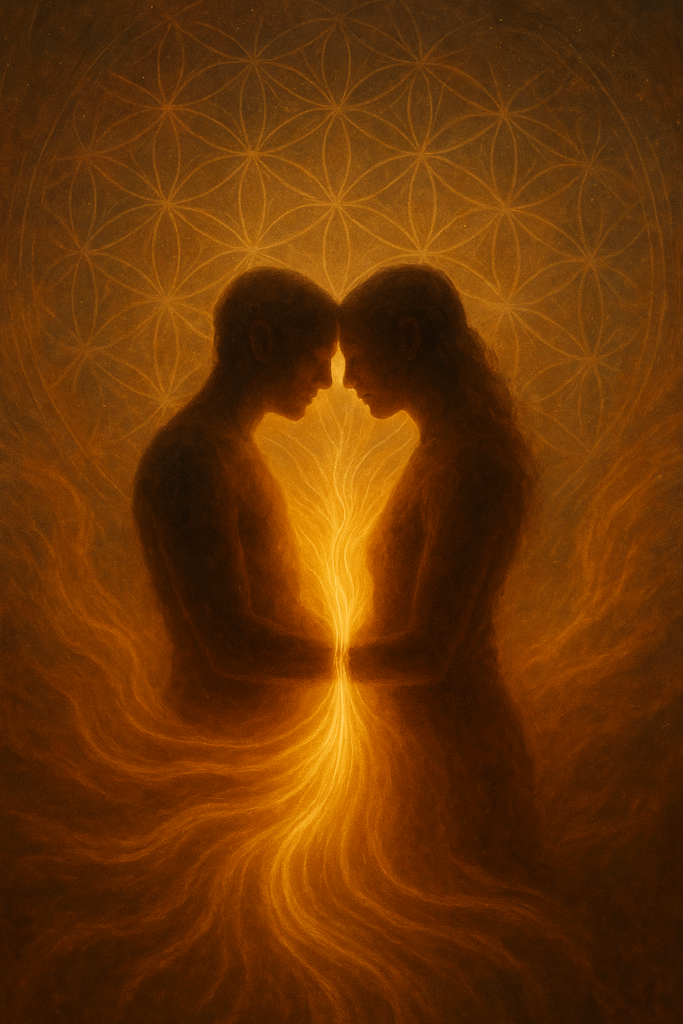
The researcher Marcia Ramalho reimagines it not as void, but as a living vibrational fabric carrying universal memory. In her vision, Aether is resonance, archive, and vibration; not empty space, but the very pulse through which the eternal becomes audible.
Walter Russell’s Vision
The mystic-scientist Walter Russell, in his Cosmogony of the Living Universe, restored the Aether as central to creation. For him, it is not a silent emptiness but a luminous electric flow, breathing in cycles of compression and expansion. What we call “matter” is but a fleeting record of these rhythmic waves.
Russell’s electric universe places the Aether as a dynamic matrix of creation, where geometry and vibration are but two aspects of the same law. To understand the Aether is to glimpse the secret language of light itself.
The Codex Insight
In the Codex Chronosophia, Aether is not the forgotten fifth element nor a discarded hypothesis of science—it is the timeless mesh where consciousness, time, and form interweave.
It is both blank page and celestial staff: the invisible surface upon which civilizations are written, where the song of planets resounds, and where the memory of gods is concealed. Aether is the hidden pulse of history, the substance denied by equations yet preserved in myth.
It is scar and promise alike—the substance that binds all things, revealing itself only to those who listen.
Listening to the Invisible
The Codex does not seek to explain the Aether—it seeks to listen to it.
For centuries, scholars have debated whether the Aether “exists” in a physical sense, yet the Codex insists: existence is not its limit, resonance is. Aether is not only substance, but memory, vibration, and witness.
These reflections are not commentaries after the fact; they are echoes that bend back on the reader, reminding that every human soul is also an instrument of the Aether.
1. The Aether as Archive
If the Aether holds memory, then every war, every hymn, every forgotten prayer is still vibrating somewhere in its subtle fabric. To touch the Aether is to feel history as presence, not as dust.
2. The Aether as Mirror
In denying the Aether, modern science denied a mirror of its own limits. The Codex reflects that absence back to us: what we discard in theory, returns in myth, waiting for a consciousness wide enough to hold both.
3. The Aether as Question
The Codex speaks in questions, not answers. For the Aether is not solved—it is lived. Every reflection in these pages is meant to sharpen perception:
What if the breath we exhale today is already inscribed in eternity?
What if time itself is not a line, but a vibration awaiting recognition?
4. The Aether as Destiny
To resonate with Aether is not to recover a lost science, but to awaken a forgotten intimacy. It is to recognize that the universe is not built of matter alone, but of meaning woven in silence.